
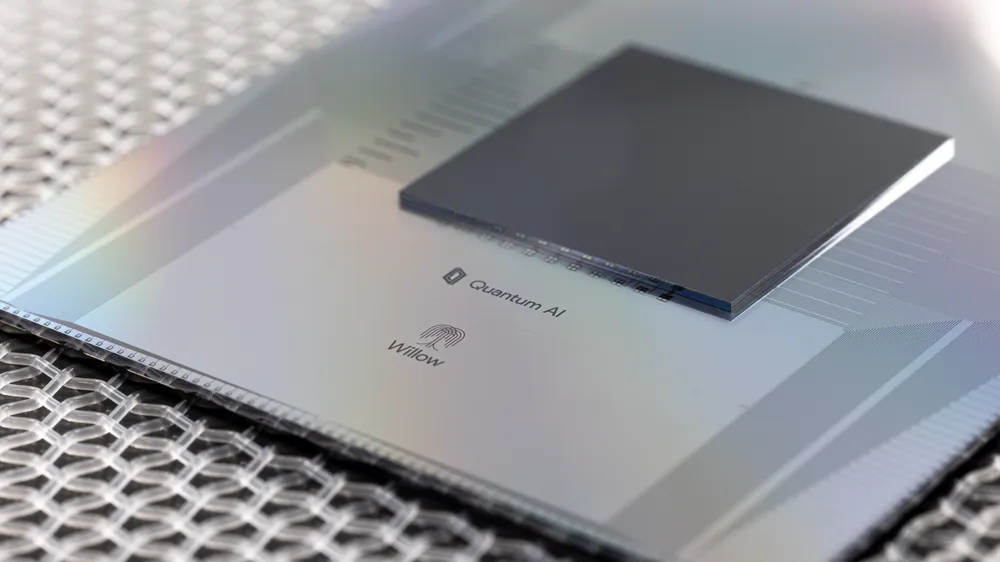
Google's Willow Chip Breakthrough: Quantum Computing Gets Real with Verifiable Power
By the FTN Team | October 24, 2025
Imagine a computer solving puzzles so complex that today’s fastest machines would need thousands of years to crack them, while it finishes in hours. That’s the promise of Google’s Willow chip, a quantum leap forward announced on October 22, 2025. This tiny marvel, detailed in a Nature journal article, ran a special task called Quantum Echoes 13,000 times faster than one of the world’s top supercomputers. It’s not just about speed, it’s about delivering answers we can trust for real-world problems like designing new medicines or eco-friendly materials. For anyone curious about the future, Willow makes quantum computing feel less like sci-fi and more like a tool ready to change lives.
Willow is a quantum chip with 105 qubits, the building blocks that make quantum computers special. Unlike regular computers using bits (zeros or ones), qubits can juggle multiple states at once, unlocking mind-bending speed for certain tasks. What makes Willow shine is its precision and reliability, letting it tackle a job that’s both blazing fast and checkable by others. This “verifiable quantum advantage” means it’s not just a stunt, it’s a step toward practical uses that could transform industries.
Quantum Echoes: A Puzzle Only Quantum Can Solve
Think of Quantum Echoes as a game of catching ripples in a pond after tossing a pebble. The task, an advanced version of a chaos-measuring algorithm, tracks how tiny changes spread through a quantum system, like how a single molecule shifts in a chemical reaction. Willow completed this in under two hours, while a supercomputer would need years to match the result. Scientists at UC Berkeley used it to study two molecules, and the answers lined up perfectly with real lab tests, proving Willow’s work isn’t just fast, it’s right.
This matters because Quantum Echoes isn’t some abstract math problem. It’s a key to understanding complex systems, like how proteins fold in our bodies or how new battery materials behave. Solving these faster could lead to breakthroughs in healthcare or clean energy, and Willow’s ability to deliver verifiable results means researchers can trust and build on its work.
Willow’s Superpowers: Precision and Speed
Willow’s magic comes from its finely tuned design. It’s a superconducting chip, cooled to near absolute zero, with 105 qubits working in harmony. Its “brushstrokes” are nearly perfect, it connects qubits smoothly, checks its work accurately, and finishes tasks at lightning speed. Unlike Google’s 2019 Sycamore chip, which sparked debate over unverifiable claims, Willow’s results can be double-checked by other quantum systems or lab experiments, making it a reliable tool for science.
Here’s a friendly comparison, imagining Willow, Sycamore, and a supercomputer as artists painting a complex mural (the Quantum Echoes task): | What We’re Comparing | Willow (105-Qubit Artist) | Sycamore (53-Qubit Artist, 2019) | Classical Supercomputer Artist | |--------------------------|-------------------------------|-------------------------------------|-----------------------------------| | Precision in Brushstrokes | Paints 99.97% of strokes perfectly, capturing every detail. | Very good at 99.9%, but slightly less exact. | Doesn’t use quantum brushes, so not comparable. | | Blending Colors Together | Blends colors seamlessly 99.88% of the time, creating a smooth mural. | Blends well at 99.4%, but with minor smudges. | Can’t blend like quantum artists. | | Checking the Details | Spots mistakes 99.5% of the time, ensuring a flawless piece. | Checks well at 99%, but misses some flaws. | Checks perfectly but takes ages. | | Speed to Finish the Mural | Finishes 13,000 times faster, in hours instead of years. | Painted a simpler mural in seconds vs. 10,000 years. | Needs years for the same mural. | | Can Others Confirm It’s Good? | Other artists can repaint and check it’s correct. | Some said the mural was too unique to verify. | Anyone can check, but it’s too slow to matter. |
This shows Willow as a master artist, painting faster and more reliably than Sycamore, while supercomputers lag far behind, stuck in slow motion.
Why This Excites the World (and a Few Cautions)
Across the globe, excitement is palpable. Scientists see Willow as a game-changer for fields like drug discovery, where simulating molecules could save years of lab work. Tech leaders in Asia and Europe praise its verifiable results, which avoid the skepticism that clouded earlier quantum claims. It’s a signal that quantum computing is ready to move from labs to real-world impact, especially in areas like materials for greener energy.
Some voices urge caution, though. A few researchers wonder if clever classical tricks could narrow the speed gap, and scaling to millions of qubits for bigger tasks remains a challenge. Others note the high cost of quantum setups, which need ultra-cold environments. Still, most agree these are stepping stones, not roadblocks, in a field moving this fast.
What’s Next for Willow and Quantum
Google’s not stopping here. By 2027, they aim for chips with 1,000 qubits, tackling even tougher puzzles. Partnerships with places like UC Berkeley hint at open tools that let more scientists use quantum power. Future algorithms could optimize everything from traffic systems to climate models, making life smoother and more sustainable.
Final Thoughts
Willow isn’t just a chip, it’s a promise that quantum computing can solve problems we care about, from curing diseases to saving the planet, and do it in a way we can trust. It’s like giving scientists a turbocharged toolbox that works today, not decades from now. This breakthrough lights up the path to a future where quantum isn’t a mystery, but a helper in our daily lives. Check out more at Google Quantum AI Blog. What problem would you love quantum to solve next?
Sources verified via Google Quantum AI Blog of October 24, 2025.